
RFID Installation Solutions:
A successful RFID deployment isn’t just about choosing the right hardware; it is about mastering the physical environment. Whether you are installing a single portal or a global warehouse network, these RFID installation solutions ensure maximum read rates and zero guesswork.
1. The Physical Layer: Antenna Placement & Polarization
The most common point of failure is antenna misalignment.
-
Mounting Height: For dock door portals, antennas should be angled to create a “read zone” that accounts for the highest and lowest possible tag locations on a pallet.
-
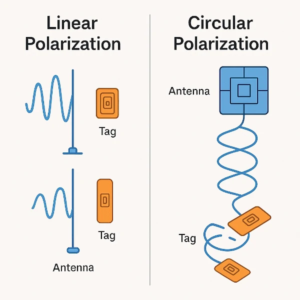
Polarization Logic: Use Circular Polarization for environments where tag orientation is unpredictable. Reserve Linear Polarization for high-speed, fixed-path applications where the tag’s orientation is strictly controlled.
2. Signal Attenuation & Environmental Shielding
Interference is the “silent killer” of ROI.
-
Multipath Interference: Metal racking and liquid containers reflect or absorb RF energy.
-
The Solution: Use RF-absorbing foam or specialized shielding behind antennas to prevent “back-lobe” reads (picking up tags behind the antenna) and to focus the energy exactly where it belongs.
3. Power & Network Connectivity
-
PoE vs. Local Power: If using Power over Ethernet (PoE), ensure your switch provides enough wattage (PoE+ or UPoE) to support the reader at maximum transmit power (typically 30dBm to 31.5dBm).
-
Cable Loss: Minimize the distance between the reader and the antenna. Every foot of LMR-195 or LMR-400 cable introduces signal loss that can significantly shrink your read range.
4. Tag Benchmarking & Placement
-
Material Matters: Never apply standard tags directly to metal or liquid-filled containers. Utilize on-metal RFID tags with a built-in spacer to ensure the antenna can “energize” the tag’s chip.
-
Orientation: Align the tag’s antenna with the reader’s polarization for a 15%–20% boost in read distance.
Expert RFID Support for Your Next Project
If your installation is hitting roadblocks, don’t guess. From remote reader configuration to site-specific troubleshooting, we provide the technical clarity needed for a seamless launch. Click here!
—————————————————————————————————————-
Frequently Asked Questions: RFID Installation & Support
1. What are the most common causes of poor RFID read rates during installation? Poor read rates are usually caused by environmental interference (multipath), incorrect antenna polarization, or using the wrong tag for the material. Ensuring that antennas are not pointed directly at metal surfaces and that tags are “tuned” for the specific substrate (like metal or liquid) is the first step in troubleshooting.
2. How do I choose between Linear and Circular polarization for my antennas? If your tags are always in the same orientation (e.g., on the side of a box on a conveyor), Linear Polarization offers more concentrated power and longer range. If the tag orientation is unknown or random (e.g., inside a shipping bin), Circular Polarization is required to ensure the signal can reach the tag from multiple angles.
3. Can I use standard RFID tags on metal surfaces? No. Standard tags will be “detuned” by the metal, resulting in zero read range. You must use specialized On-Metal RFID tags which feature a built-in spacer or specialized antenna design to allow the RF signal to reflect off the metal correctly without shorting out the tag’s chip.
4. What is the maximum recommended cable length between a reader and antenna? To minimize signal loss (attenuation), you should keep antenna cables as short as possible. For standard LMR-195 cables, try to stay under 20 feet. If you must go longer, you should upgrade to a lower-loss cable like LMR-400 or LMR-600 to ensure the antenna still receives sufficient power to energize tags at a distance.
5. How do I eliminate “stray reads” during a warehouse deployment? Stray reads occur when an antenna picks up tags outside of the intended read zone (like the next dock door over). This is fixed by reducing the reader’s transmit power, adjusting the antenna’s “beamwidth” or tilt, and occasionally using RF-shielding materials to create a physical barrier for the signal.
Still having trouble? We offer expert RFID Support and remote troubleshooting to get your system back on track.“